


For six years, the most-cited measurement of web accessibility moved in the same direction: slowly, grudgingly, better. In February 2026 it reversed. WebAIM scanned the home pages of the top one million websites and found 56.1 accessibility errors per page, up 10.1% in a single year. The share of pages with at least one detectable failure rose from 94.8% to 95.9%. Six years of marginal progress erased in twelve months.
WebAIM named a cause. Not budgets, not awareness, not regulation. The report points at the rapid adoption of AI-assisted development — “vibe coding” — and the page complexity it produces.
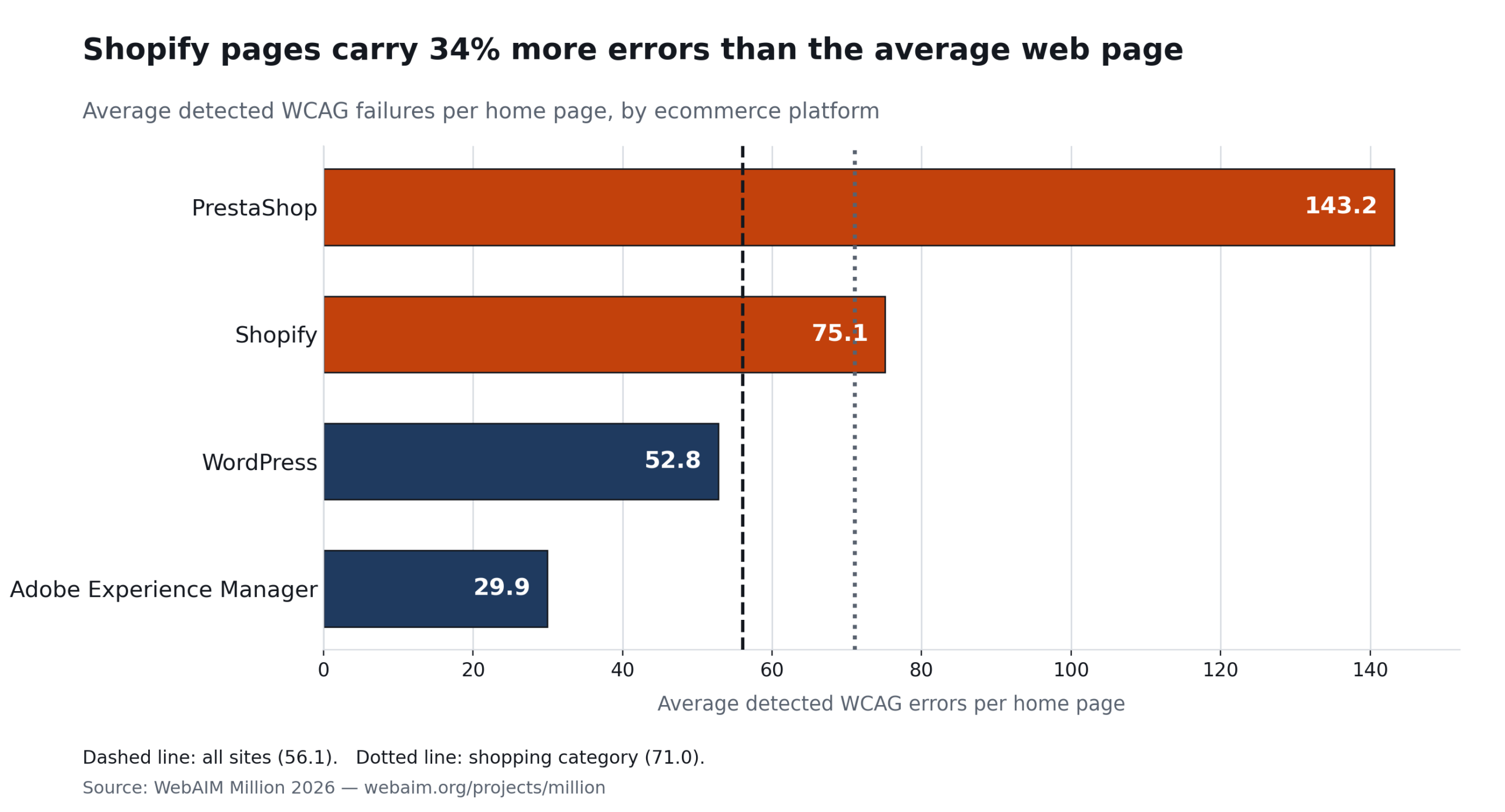
If you run an online store, this is not an industry curiosity. Shopping sites came in at 71.0 errors per home page, the second-worst of twenty-nine categories measured. And the litigation that follows accessibility failures is concentrating on ecommerce with a precision that should alarm anyone who has shipped a storefront in the last two years.
What actually got worse
The interesting number in the 2026 report is not the error count. It is the element count.
The average home page now contains 1,437 elements — up 22.5% in one year, and nearly double what it was in 2019. Pages are not getting worse because developers forgot how to write a label. They are getting worse because there is dramatically more of them, produced dramatically faster, and the error rate per element has held roughly steady while the denominator exploded. WebAIM found one error for every twenty-six page elements.
ARIA tells the same story from another angle. The average page now carries 133 ARIA attributes, up 27% in a year and six times the 2019 figure. ARIA is the toolkit for making complex widgets accessible — and pages using it averaged 59.1 errors versus 42.0 for pages without it. That correlation does not prove ARIA causes errors; ARIA-heavy pages are more complex to begin with. But it does demolish a comfortable assumption. Adding accessibility-shaped code is not the same as adding accessibility.
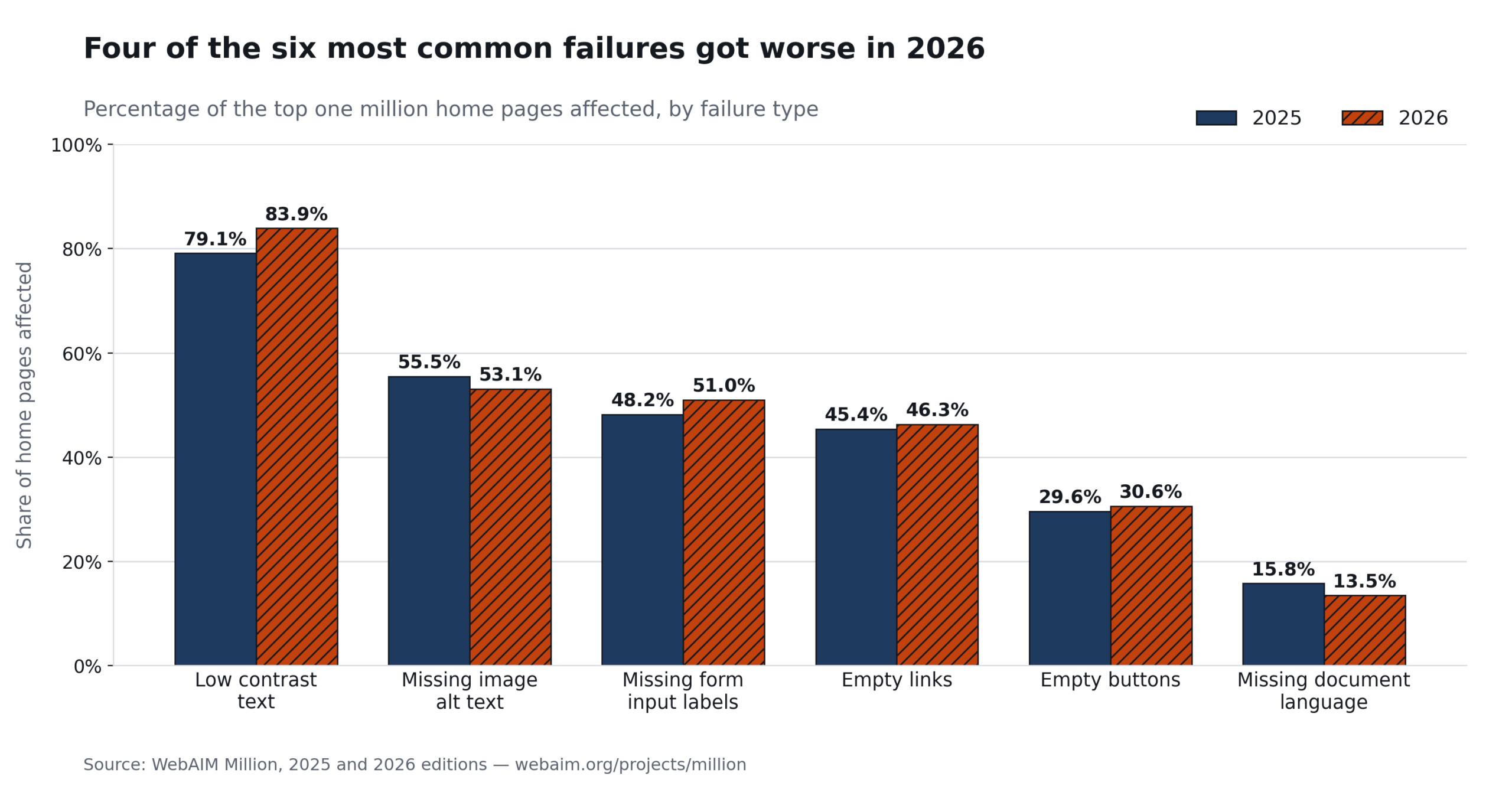
Note what these failures are. Low contrast text. Missing alt text. Unlabelled form inputs. Empty links and buttons. Not one of them is an exotic edge case. They are the first things any competent accessibility review catches, they have topped this list for seven straight years, and low contrast text alone now affects 83.9% of home pages — up nearly five percentage points in a single year.
What the research says about AI-generated interfaces
WebAIM’s attribution to AI-assisted development is an inference from aggregate data. But there is now a controlled evidence base underneath it, and almost none of it has reached the people actually building stores.
The largest study to date was published in April 2026. Fifty-four designers built interfaces manually in Figma, then generated comparable designs using six AI tools. Across 21,880 accessibility assessments, the AI-generated interfaces achieved 29.0% compliance. Colour contrast passed 26.8% of the time. Use of colour — conveying information by colour alone — passed 19.2%.
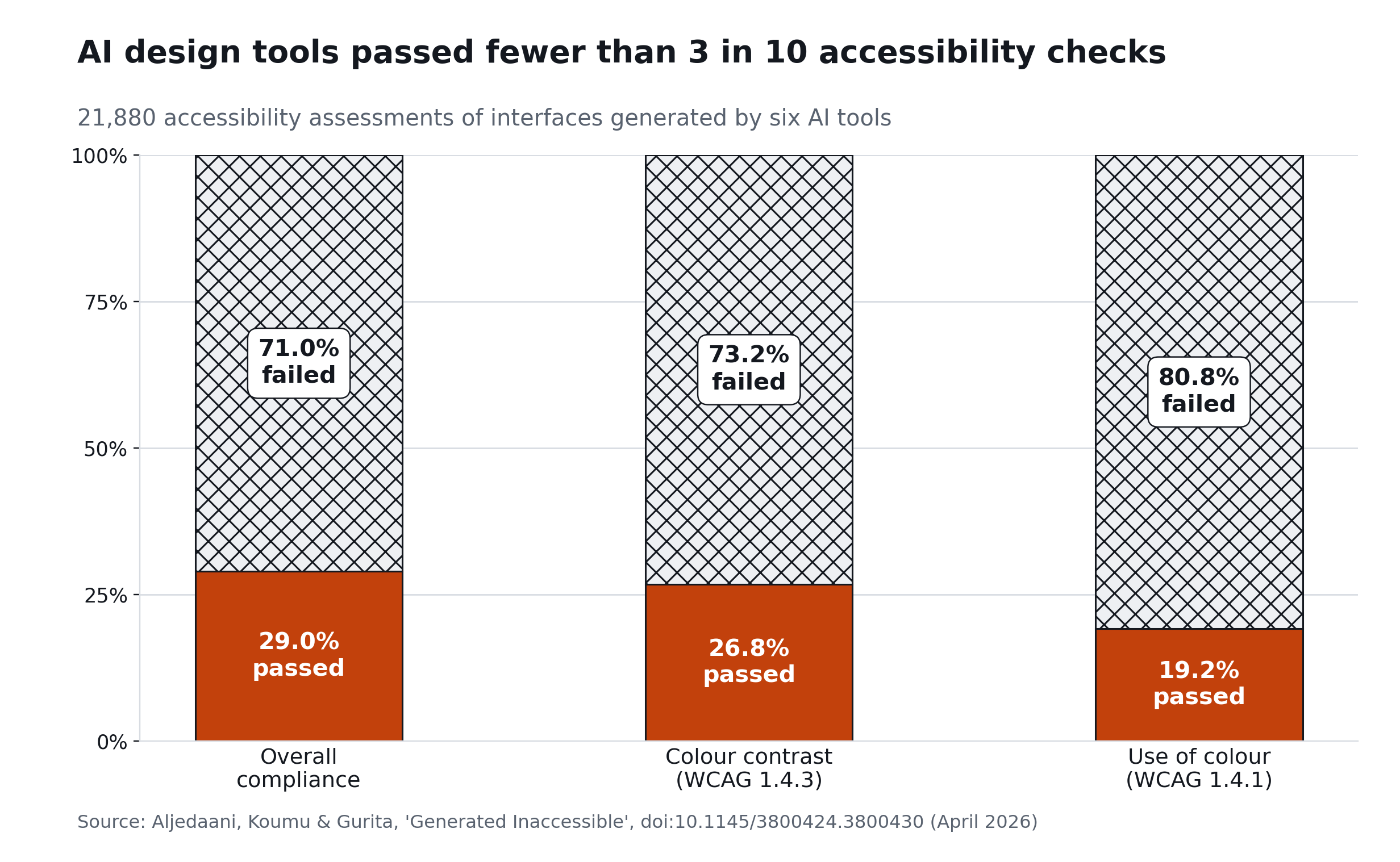
Two findings from that study deserve more attention than the headline number.
First, remediation cost. 39% of the violations in AI-generated designs required “major redesign” to fix, against 22% for the manually created ones. AI failures are not evenly distributed across severity — they cluster in structural decisions that are expensive to unwind after launch.
Second, and more uncomfortable: explicitly asking for accessibility in the prompt made compliance worse, not better. The instruction most people would reach for as a fix did not work. An earlier 2025 study found the same directional oddity in automated scores, while expert reviewers judged accessibility-prompted output to have less severe violations — average severity dropping from 1.53 to 0.30 on a five-point scale. The honest reading is that prompting shifts what breaks without reliably reducing how much breaks, and that automated scores and expert judgement can tell opposite stories about the same code.
A 2024 study had 88 developers build sites with ChatGPT: 84% contained accessibility problems. The most common failure categories, as a share of all violations found, were text resizing (31.8%), colour contrast (26.6%), and information-and-relationships — the semantic structure screen readers depend on — at 16.8%.
The part that complicates the story
Here is where most coverage of this topic would stop, and where stopping would be dishonest.
A peer-reviewed study published in ACM Transactions on Software Engineering and Methodology in June 2026 compared code from GPT-4o, Gemini, and Qwen against human-written code. It found that the language models often produced more accessible code than humans for basic features — colour contrast and alternative text specifically — while performing worse on complex features, particularly ARIA attributes.
So “AI writes inaccessible code” is too crude to be useful. What the evidence actually supports is narrower and more interesting:
- AI changes the profile of failures. It is comparatively reliable on the mechanical, checkable things. It is unreliable on semantic structure, keyboard behaviour, focus management, and ARIA — precisely the barriers that stop someone from completing a purchase, and precisely the ones automated scanners are worst at detecting.
- AI changes the volume. A 22.5% jump in page elements in one year is the mechanism. Even a constant error rate produces far more total barriers when output scales like that.
- AI does not supply the judgement. A 2024 study of AI coding assistants found they improved accessibility outcomes only when the developer already had accessibility expertise. The tool amplifies what the person brings. If they bring nothing, it amplifies nothing.
That last point is the one worth sitting with. The people most likely to build a storefront with an AI tool are the people least likely to know what a skip link is.
Why this bill lands on ecommerce
Because the legal system has already found you.
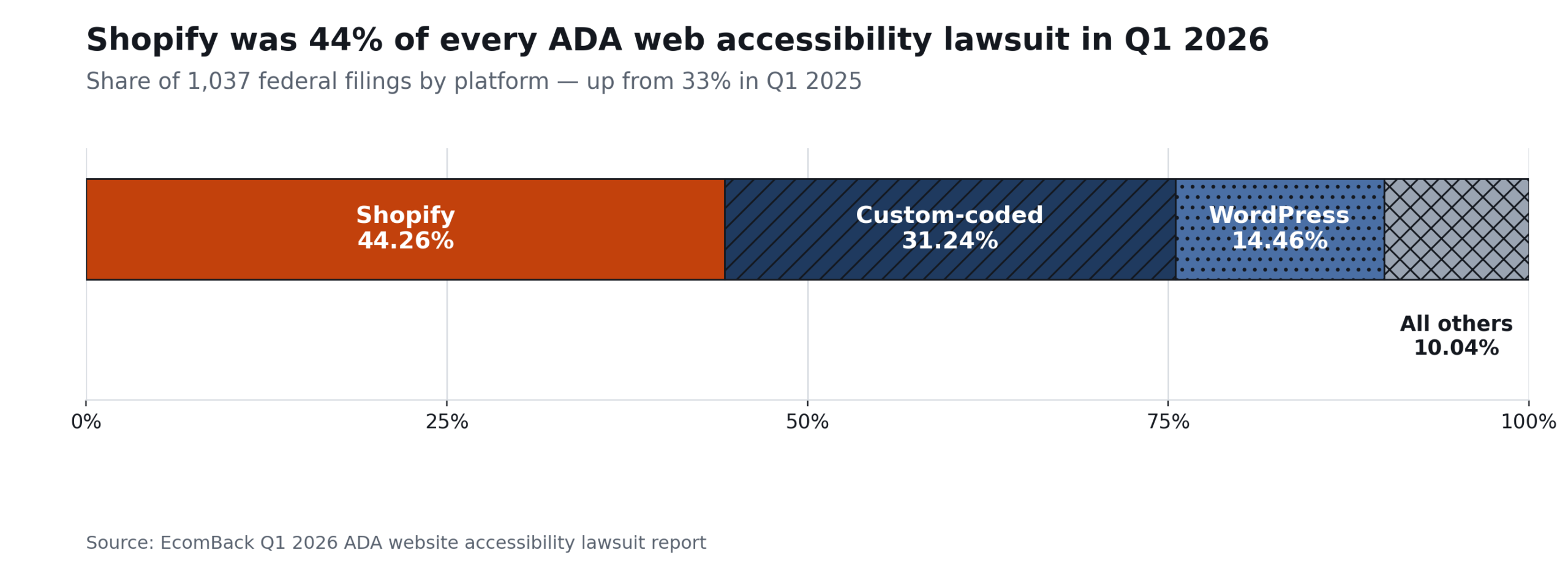
In the first quarter of 2026, Shopify stores accounted for 44.26% of every federal ADA website accessibility lawsuit filed — 459 of 1,037 cases. A year earlier it was 33.06%. That is not a platform problem in the sense that Shopify is uniquely negligent; it is a concentration problem. Shopify is where small and mid-sized ecommerce lives, storefronts share a small number of theme patterns, and a plaintiff’s tester can document the same barriers across hundreds of stores in an afternoon.
It is worth knowing what your platform already admits. Shopify’s own accessibility conformance report for its default Dawn theme lists “partially supports” against thirteen success criteria — including keyboard operation, focus order, and error identification. It specifically notes that submitting the account address form with invalid data produces no error message at all. That report is dated November 2021. It has not been refreshed in nearly five years, and it never covered the third-party apps that inject reviews widgets, popups, chat launchers, and filter controls into your critical path.
WooCommerce is in a comparable position from the other direction. Its June 2025 conformance report documents a keyboard trap in deprecated filter blocks that still exist on older stores — but the report tested only core WooCommerce on the default Twenty Twenty-Four theme, explicitly excluding every extension plugin and every custom theme. Which is to say it excluded what nearly every real store runs.
The arithmetic of ignoring it
Filings are not tapering. Independent trackers disagree on methodology and agree on direction: Seyfarth Shaw counted 3,117 federal web accessibility suits in 2025, up 27%; UsableNet, which also counts state courts, projects more than 6,000 for 2026. July 2026 alone produced 401 new federal filings.
Lawsuits are the visible part. The estimated 35,000 to 50,000 demand letters sent in 2025 — roughly seven to ten for every suit actually filed — are where most merchants encounter this, quietly, and settle without ever appearing in a statistic.
| How it resolves | Average | Range |
|---|---|---|
| Demand letter, no suit filed | $5,000 | $1,000 – $25,000 |
| Out-of-court settlement | $30,000 | $5,000 – $150,000 |
| Court judgment | $85,000 | $10,000 – $500,000 |
| Class action | $400,000 | $50,000 – $6,000,000+ |
| Legal defence when you win | $30,000 | $5,000 – $125,000 |
That last row is the one merchants misjudge. Winning is not free.
At the top end: Fashion Nova settled a class action for $5.15 million in 2025, the largest web accessibility settlement since the National Federation of the Blind’s $6 million case against Target in 2008. California’s Unruh Civil Rights Act carries $4,000 in minimum statutory damages per violation with no requirement to prove actual harm, which is exactly why plaintiffs route California claims into state court.
And if you are telling yourself you are too small: 64% of businesses sued in the first half of 2026 had annual revenue under $25 million. Targets are found by automated scanning, not by revenue screening. Restaurants and food businesses were 32.21% of Q1 2026 filings; fashion and apparel 25.17%. Together, nearly 60%.
Two things that will not save you
The deadline extension was not yours. In April 2026 the Department of Justice pushed its web accessibility compliance deadlines back a year, to April 26, 2027 for larger public entities and April 26, 2028 for smaller ones. That rule is Title II. It governs state and local government. If you sell things online, you are under Title III — which has no compliance deadline to extend, because the obligation flows from the statute through three decades of case law rather than from a date on a calendar. Nothing about your exposure changed on April 20, 2026. Filings continued at record pace all year.
The widget is not a defence. In Q1 2026, 265 of the 1,037 businesses sued — 25.55% — already had an accessibility overlay installed when the complaint landed. By July that share had risen to 28.2%. The trend is going the wrong way for anyone treating a monthly subscription as insurance.
It is also a regulatory matter now. In April 2025 the Federal Trade Commission approved a final order requiring overlay vendor accessiBe to pay $1 million over claims that its AI-powered tool could make any website WCAG-compliant; the FTC found those claims “false, misleading, or unsubstantiated.” The same action charged that the company placed articles on third-party sites “formatted to look like impartial and objective reviews” — so some of the reassuring coverage a merchant might have read while shopping for a widget was itself part of the finding.
What to do instead, in order
The good news buried in the WebAIM data is that the problem is narrow. Six failure types account for 96% of all detected errors, and they have been the same six for seven years. You are not facing an unbounded engineering programme.
- Run the keyboard test yourself, today. Put your mouse down. Load your product page and press Tab repeatedly. You are looking for three things: whether you can always see where you are, whether you can reach and operate every filter, variant selector, and add-to-cart control, and whether you can get back out of any popup or drawer you get into. If you cannot complete a purchase this way, neither can a keyboard-only shopper — and a plaintiff’s tester will document it in minutes. This costs you thirty seconds and no money.
- Fix contrast and labels first. They are the two most common failures on the web, they are the cheapest to correct, and they are the most consistently cited in complaints.
- Audit the apps, not just the theme. No platform conformance report covers your installed apps. Review widgets, cookie banners, popups, and filter plugins are outside every VPAT you have been shown.
- Do not trust a scan alone. Automated tools are commonly estimated to catch only a third or so of real barriers. They are good at contrast and missing labels and blind to keyboard traps, focus order, reading order, and misused ARIA — which is exactly where AI-generated code is weakest. The measured figures in this article are floors, not ceilings.
- Keep the evidence. A documented audit with dated remediation tickets is what separates a cheap resolution from an expensive one. Missouri’s SB 907, effective August 28, 2026, goes further: it creates a rebuttable presumption that a claim is abusive if the business made substantial good-faith fixes within 90 days of being notified. It protects businesses that act. It does nothing for businesses that ignore the letter.
The regression was a choice
None of this is an argument against building with AI. It is an argument against shipping what AI produces without looking at it.
The 2026 numbers describe an industry that got faster without getting more careful: pages 22.5% heavier in a year, ARIA usage up 27%, and the first measured decline in accessibility since 2020. Meanwhile the addressable market on the other side of those barriers is not small — Disability:IN and the American Institutes for Research put the US disability consumer market at $675 billion in 2026, with $107 billion in annual discretionary spending.
Your store is either reachable by those customers or it is not, and right now the odds are documented: 95.9% of home pages fail, shopping sites fail worse than almost every other category, and 44% of the lawsuits are landing on the platform most of you are running.
The thirty-second keyboard test above will tell you which side of that line you are on. Everything after that is just deciding whether to find out before someone else does.
Sources
- WebAIM Million 2026 and 2025 editions — webaim.org/projects/million
- Aljedaani, Koumu & Guriță, “Generated Inaccessible: Measuring WCAG Violations in AI UI Design Tools,” April 2026 — doi:10.1145/3800424.3800430
- Suh, Tafreshipour, Malek & Ahmed, “An Empirical Study on Evaluating Accessible Code Generation Capabilities of LLMs,” ACM TOSEM, June 2026 — doi:10.1145/3820782
- Guriță & Vatavu, “When LLM-Generated Code Perpetuates User Interface Accessibility Barriers,” 2025 — doi:10.1145/3744257.3744266
- Aljedaani et al., “Does ChatGPT Generate Accessible Code?”, 2024 — doi:10.1145/3677846.3677854
- Mowar, Peng, Steinfeld & Bigham, “Tab to Autocomplete: The Effects of AI Coding Assistants on Web Accessibility,” 2024 — doi:10.1145/3663548.3688513
- EcomBack, Q1 2026 and 2025 annual ADA website accessibility lawsuit reports
- Seyfarth Shaw, ADA Title III blog — adatitleiii.com
- UsableNet 2026 midyear digital accessibility litigation report
- Federal Trade Commission, In the Matter of accessiBe Inc., case 2223156 — final order April 2025
- Shopify Dawn theme accessibility conformance report, November 2021; WooCommerce accessibility conformance report v10.0, June 2025
- Disability:IN and the American Institutes for Research, “The Next Growth Market: Inside the $675 Billion Consumer Opportunity,” June 2026
Figures in this article are drawn from the sources above and are current as of September 2026. Where automated testing is the underlying method, the reported numbers represent detectable errors and should be read as minimums.