
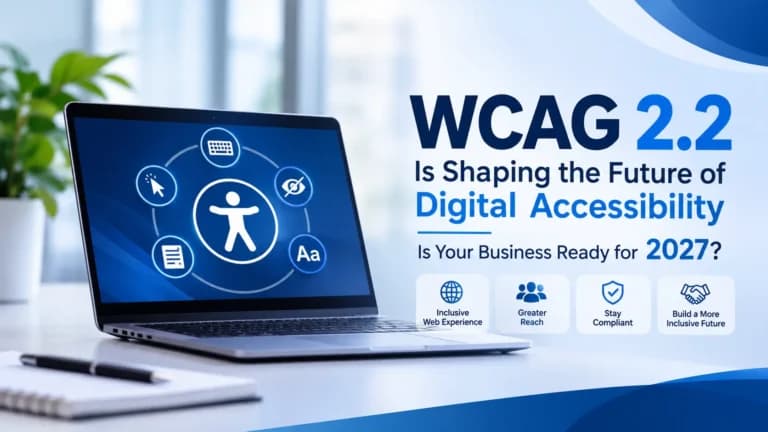
Digital accessibility is entering a new chapter, and 2027 is becoming an important milestone for organizations worldwide.
From updated European accessibility standards to approaching U.S. compliance deadlines, the expectations surrounding accessible digital experiences continue to evolve.
In September 2026, the European accessibility standard EN 301 549 was updated to incorporate WCAG 2.2. Meanwhile, U.S. public-sector organizations are preparing for revised accessibility compliance deadlines beginning in April 2027.
For businesses, the message is clear: accessibility should no longer be treated as a last-minute compliance exercise. It belongs in the way digital products are designed, developed, tested, and maintained.
So, what has changed, and how should organizations prepare?
1. Europe’s New Accessibility Standard Signals a Shift Toward WCAG 2.2
One of the most significant accessibility developments of 2026 came in September, when Europe published EN 301 549 version 4.1.1.
The updated standard incorporates WCAG 2.2, expanding accessibility expectations for websites, applications, software, and digital documents.
WCAG 2.2 introduces improvements that address common challenges experienced by people with disabilities, including:
- Accessible authentication: Making login experiences easier for users with cognitive disabilities.
- Focus visibility: Helping keyboard users identify where they are navigating.
- Target size: Making interactive elements easier to activate.
- Consistent help: Making support options easier to locate.
- Redundant entry: Reducing unnecessary repetition when completing forms.
Important distinction: The September 2026 update does not automatically make WCAG 2.2 the legally referenced standard across Europe. Formal citation in the Official Journal of the European Union is still required.
Nevertheless, the update gives organizations a clear direction for future accessibility planning.
What this means for businesses
Organizations should begin reviewing their digital products against WCAG 2.2 Level AA, even where current regulations still reference WCAG 2.1 AA.
Preparing early can reduce future remediation work and improve digital experiences today.
2. U.S. Accessibility Deadlines Are Moving Closer
In April 2026, the U.S. Department of Justice extended compliance deadlines under the Americans with Disabilities Act (ADA) Title II web accessibility rule.
The revised deadlines are:
- April 26, 2027: State and local government entities serving populations of 50,000 or more.
- April 26, 2028: Smaller public entities and special district governments.
The rule generally requires covered web content and mobile applications to conform to WCAG 2.1 Level AA, subject to regulatory exceptions.
Although these specific deadlines apply to covered public entities rather than every private business, they highlight the growing importance of digital accessibility.
Organizations that provide digital services to government agencies should also pay attention to accessibility requirements in procurement and vendor agreements.
Why waiting is risky
Accessibility improvements often involve more than changing colors or adding image descriptions.
Organizations may need to review navigation, forms, authentication, documents, third-party integrations, and mobile applications.
Addressing these areas early gives teams more time to prioritize improvements, validate changes, and incorporate accessibility into regular development processes.
3. AI Is Accelerating Development, but Accessibility Still Requires Human Judgment
Artificial intelligence is changing how digital products are built.
Developers can generate components, create interfaces, and automate repetitive tasks faster than ever.
But faster development does not automatically mean accessible development.
AI-generated interfaces can still introduce barriers such as:
- Missing or incorrect accessible labels.
- Keyboard navigation problems.
- Inaccessible custom components.
- Poorly communicated form errors.
- Incorrect use of accessibility attributes.
These issues can affect real users even when an interface appears visually polished.
Automated accessibility tools are valuable for identifying many detectable problems, but they cannot fully evaluate whether someone using assistive technology can successfully complete a task.
The most effective approach combines automated testing, manual evaluation, and feedback from people with disabilities.
Accessibility needs to be part of development workflows rather than a final checkpoint before launch.
4. Accessibility Is Becoming a Business Priority, Not Just a Compliance Requirement
Consider a customer trying to complete an online purchase.
They find the product, add it to their cart, and proceed to checkout.
But the payment form cannot be completed using a keyboard.
For that customer, the transaction effectively ends there.
This illustrates why accessibility matters beyond regulatory obligations.
Accessible digital experiences can help organizations:
- Reach customers who encounter barriers with inaccessible websites.
- Improve usability across devices and interaction methods.
- Reduce friction in registration, checkout, and support journeys.
- Strengthen inclusive customer experiences.
- Identify accessibility problems earlier in product development.
Accessibility is not simply about meeting technical requirements. It is about enabling more people to use digital services independently and effectively.
5. Five Practical Steps to Prepare for 2027
Organizations do not need to wait for another regulatory deadline to begin improving accessibility.
A practical roadmap starts with five actions.
Step 1: Assess your current accessibility position
Review websites, mobile applications, digital documents, and critical customer journeys against the applicable accessibility requirements.
Step 2: Prioritize high-impact barriers
Start with issues that prevent users from completing essential tasks, including navigation, authentication, form submission, and checkout.
Step 3: Incorporate WCAG 2.2 into your roadmap
Even where WCAG 2.1 AA remains the applicable legal benchmark, evaluating WCAG 2.2 can help teams prepare for evolving expectations.
Step 4: Combine automated and manual testing
Use automated tools to identify detectable issues, then validate real-world interactions through keyboard testing, assistive technology, and human review.
Step 5: Make accessibility continuous
Introduce accessibility checks into design reviews, development workflows, quality assurance, and release processes.
A sustainable accessibility program is built through consistent improvements rather than occasional audits.
6. How Zylyn Fits Into Your Accessibility Journey
As accessibility expectations evolve, organizations need a structured approach to identifying barriers, prioritizing improvements, and maintaining accessible digital experiences.
Zylyn’s focus on digital accessibility, WCAG compliance, and inclusive design aligns with these challenges.
Whether your organization is reviewing its existing website, improving development practices, or preparing for changing accessibility expectations, the first step is understanding where barriers exist and how to address them.
The goal should not simply be to pass an audit.
It should be to create digital experiences that more people can use.
Final Thoughts: Accessibility Readiness Starts Before the Deadline
The developments of 2026 point toward a broader shift in digital accessibility.
Europe is preparing for WCAG 2.2 adoption through its updated technical standard. U.S. public-sector accessibility deadlines are approaching. And AI-assisted development is making consistent accessibility testing increasingly important.
For organizations planning their 2027 digital strategy, accessibility deserves a place alongside performance, security, usability, and customer experience.
The question is no longer whether accessibility matters. It is whether your organization is building accessibility into its digital future.
Ready to Take the Next Step?
Explore accessibility insights, practical guidance, and compliance resources from Zylyn.
Visit Zylyn to learn more about building accessible digital experiences.