

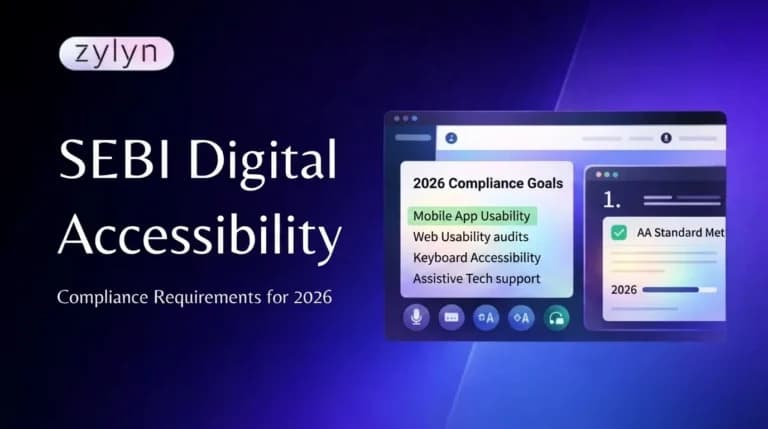
On July 31, 2025, the Securities and Exchange Board of India (SEBI) made a historic decision: SEBI digital accessibility compliance is no longer optional.
For the first time, India’s financial regulator explicitly mandated that all digital platforms serving investors must be accessible to persons with disabilities. This wasn’t a recommendation. It wasn’t aspirational. It was a legal requirement.
This matters because 26 million Indians live with disabilities. And most of India’s financial services—trading, investing, KYC processes, account access—happen entirely online. For these millions, inaccessible platforms mean exclusion from basic financial participation.
SEBI’s mandate is rooted in two pillars:
- Legal: The Rights of Persons with Disabilities Act, 2016 (RPwD Act) established that digital access is a fundamental right
- Constitutional: The Supreme Court of India’s April 2025 judgment reaffirmed that digital access is intrinsic to Article 21 (right to life and personal liberty)
And with a March 31, 2026 deadline fast approaching, every SEBI-regulated entity must act now.
Here’s what you need to know, what you need to do, and what happens if you don’t.
Who Must Comply? (The Scope of SEBI’s Mandate)
SEBI’s digital accessibility mandate applies to all Regulated Entities (REs) operating in India’s securities market. This is broad and comprehensive, covering almost every player in India’s financial ecosystem.
Direct SEBI reports include stock exchanges like BSE, NSE, MCX, and NCDEX, as well as depositories (CDSL, NSDL), Market Infrastructure Institutions, clearing corporations, and credit rating agencies. If you operate a major financial platform in India, you’re in this category.
Stockbrokers, clearing members, and depository participants report through their respective exchanges or depositories, but the requirement still applies. Similarly, investment advisers and research analysts now report through BSE Ltd. under the August 29 circular update.
Other regulated entities—mutual fund AMCs, KYC registration organizations, RTAs, and alternative investment funds—also fall under this mandate. Whether you’re a large multinational brokerage or a small investment adviser with a handful of clients, if you’re regulated by SEBI and you have digital platforms serving investors, you must comply.
The scope is intentionally broad because SEBI’s goal is clear: exclude no one from financial participation based on disability.
The Standards You Must Meet
SEBI doesn’t reinvent accessibility standards. Instead, it references four established frameworks that work together to create comprehensive accessibility requirements.
The foundation is the Web Content Accessibility Guidelines (WCAG 2.1 Level AA), which are international standards developed by the W3C. Level AA is the globally recognized baseline for digital accessibility and covers everything from visual accessibility (color contrast, text sizing) to motor accessibility (keyboard navigation, button sizing) to cognitive accessibility (clear language, visible focus indicators) to audio/visual accessibility (captions and transcripts). SEBI expects all websites, apps, portals, and investor touchpoints to conform to WCAG 2.1 AA, or the newer WCAG 2.2 which is backwards compatible.
Alongside WCAG, SEBI references the Guidelines for Indian Government Websites (GIGW), which is India’s national guidance for website accessibility and usability. GIGW aligns with WCAG but includes India-specific considerations like language support and mobile-first design. SEBI expects compliance with GIGW alongside WCAG.
The third standard is IS 17802:2022, which is the Indian Standard for ICT accessibility. It covers websites, apps, documents, and digital services with India-specific technical requirements. SEBI expects alignment with IS 17802 standards for Indian financial platforms.
Finally, the Rights of Persons with Disabilities Act, 2016 (RPwD Act) legally mandates that all service providers offer accessible digital experiences. Specific sections cited in the SEBI circular establish this as a fundamental obligation. SEBI expects full compliance with RPwD provisions related to digital access.
The important thing to understand is that SEBI doesn’t ask you to pick one standard. It asks you to conform to all four. The good news is that if you’re meeting WCAG 2.1 AA, you’re essentially meeting the others because they’re aligned. The standards reinforce rather than contradict each other.
The Timeline: What Must Happen When?
SEBI’s timeline was updated in December 2025 to be more practical. Here’s what regulated entities must do:
Table 1: SEBI Digital Accessibility Compliance Timeline
| Deadline | Requirement | What It Means |
| Passed: Sept 30, 2025 | Submit list of all digital platforms | Identify every platform that serves investors (websites, apps, portals, documents) |
| March 31, 2026 | Submit Readiness & Compliance Status Report (Annexure B) | Platform-wise assessment of accessibility status, issues identified, remediation plan, timeline |
| April 30, 2026 | Complete accessibility audits | Third-party IAAP-certified audits of all platforms, including usability testing with persons with disabilities |
| July 31, 2026 | Remediate all audit findings | Fix identified issues; submit evidence of remediation |
| April 30, 2027 | First annual compliance report | Submit proof that platforms meet WCAG 2.1 AA; ongoing audits planned |
| Annually thereafter | Annual accessibility reporting | Within 30 days of each financial year end, submit updated compliance status |
Critical clarification (December 2025): The March 31, 2026 deadline is NOT a “full compliance” deadline. It’s a “readiness and status reporting” deadline. SEBI wants to see:
- What platforms you have
- Where you stand on accessibility
- What you’ve found in audits (if done)
- What your remediation plan is
- Expected timeline to compliance
This is SEBI’s way of tracking progress and enforcement readiness.
What Must Be Accessible?
SEBI requires accessibility across all investor-facing digital platforms and content. This is comprehensive in scope and leaves no room for selective compliance.
Your website and portal must be accessible, including both the public-facing sections and the investor login areas. Mobile applications on both iOS and Android need to meet the standards. Trading platforms and investor dashboards are critical touchpoints that must be fully accessible. The entire KYC and e-KYC process, including document uploads and verification, must be accessible to someone using a screen reader or keyboard-only navigation.
Beyond the interactive platforms, SEBI extends accessibility requirements to all investor communication materials. Account statements, disclosures, and terms and conditions documents must be accessible. Research reports and market data need to be in accessible formats. PDFs, Word documents, Excel files, and any other documents you provide must be accessible. Video content must include captions and transcripts. Investor notifications, alerts, and email communications must follow accessibility principles. Digital forms and submission processes must be navigable without a mouse.
The practical test is simple: if an investor with a disability accesses your platform, can they navigate using keyboard only without a mouse? Can they use a screen reader to understand what’s happening? Can someone with color blindness perceive all important information? Can they understand forms and instructions clearly? Can they complete the entire KYC process without hitting accessibility barriers?
If the answer to any of these questions is “no,” you have a compliance gap that needs remediation.
The Audit Requirement: What You Must Do?
SEBI requires third-party accessibility audits conducted by IAAP-certified accessibility professionals. This is non-negotiable.
What an SEBI-compliant audit must cover:
Technical Assessment:
- Automated scanning against WCAG 2.1 AA criteria
- Manual testing by certified professionals
- Code review for semantic HTML, ARIA implementation
- Keyboard navigation testing
- Color contrast and visual design review
- Form accessibility and error handling
Usability Testing:
- Testing with actual persons with disabilities
- Screen reader user testing (JAWS, NVDA, VoiceOver)
- Voice control and speech recognition testing
- Keyboard-only navigation testing
- Cognitive accessibility assessment
Documentation:
- Detailed findings report mapping to WCAG criteria
- Screenshot evidence of failures
- Remediation recommendations with impact/effort prioritization
- Compliance roadmap with timelines
The standard: If audits identify issues, you must remediate them by July 31, 2026, with evidence submitted to SEBI.
Reporting Requirements: What You Must Submit?
Readiness Report (March 31, 2026)
SEBI’s Annexure B form requires:
For each digital platform:
- Platform name, URL, purpose, primary functionality
- Current accessibility status (compliant / partial / not compliant)
- WCAG 2.1 AA conformance level (achieved / in progress / not started)
- Accessibility issues identified (critical / high / medium / low count)
- Remediation plan (if issues exist)
- Timeline to achieve WCAG 2.1 AA compliance
- Audit status (planned / in progress / completed)
- IAAP-certified auditor name (if appointed)
Nodal Officer Information:
- Name, designation, contact details
- Responsible for accessibility coordination, grievance handling, SEBI reporting
Grievance Mechanism:
- How investors report accessibility issues
- Escalation process
- Expected resolution timeline
Annual Compliance Report (April 30, 2027 and ongoing)
Within 30 days of each financial year end:
- Certification that platforms meet WCAG 2.1 AA
- Audit completion dates and findings
- Remediation evidence
- Training conducted for staff
- Complaints received and resolutions
- Next year’s audit plan
Reporting Authority
Where to submit:
| Entity Type | Report To |
| Stock Exchanges, Depositories, MIIs | SEBI directly ([email protected]) |
| Brokers, DPs, Clearing Members | Your Exchange/Depository |
| IAs, RAs, PMs | BSE Ltd. |
| AMCs, RTAs | SEBI directly |
| KRAs, AIFs | Respective regulatory body |
Risks of Non-Compliance
Non-compliance with SEBI’s accessibility mandate carries serious legal and business risks:
Legal Risks:
- Enforcement action by SEBI (fines, show-cause notices)
- Litigation under RPwD Act (affected persons can sue)
- Violation of investor protection obligations
- Reputational damage from regulatory action
Financial Risks:
- SEBI fines (amount not yet specified but enforcement is certain)
- Legal defense costs (litigation is expensive)
- Remediation costs multiply if delayed (fixing issues costs more later)
- Loss of investor trust and potential business impact
Operational Risks:
- Your platforms continue excluding millions of potential investors
- Customer service costs increase (accessibility issues cause support calls)
- Reputational damage (financial services need trust; inaccessibility signals negligence)
- Regulatory scrutiny and audit burden
The bottom line: SEBI’s enforcement is coming. Entities that act proactively now avoid penalties and reputational damage.
The Implementation Roadmap: How to Get Compliant
If your organization isn’t yet WCAG 2.1 AA compliant, here’s a realistic roadmap to March 31, 2026 readiness:
Phase 1: Assessment (Now – February 2026)
Weeks 1-2:
- Identify all investor-facing digital platforms
- Document current accessibility maturity
- Assess internal resources and capability
Weeks 3-4:
- Run automated accessibility scans on all platforms
- Identify most critical barriers (login, trading, KYC)
- Prioritize platforms by investor traffic and regulatory risk
Weeks 5-8:
- Engage IAAP-certified accessibility auditor
- Conduct comprehensive audits of top-priority platforms
- Map findings to WCAG 2.1 AA criteria
Deliverable by Feb 28: Audit report with findings prioritized by severity
Phase 2: Readiness Reporting (Now – March 31, 2026)
Weeks 9-12:
- Complete Annexure B readiness report using audit findings
- Define remediation plan with realistic timelines
- Identify and assign Nodal Officer
- Document grievance mechanism
Deliverable by March 31: Readiness report submitted to SEBI
Phase 3: Remediation (April – July 2026)
Weeks 13-20:
- Fix critical and high-priority issues (aim for 80% completion)
- Re-test fixes with screen readers and keyboard navigation
- Document remediation evidence
- Continue platform-by-platform audits for remaining platforms
Weeks 21-26:
- Complete all remediation
- Submit evidence to auditor for validation
- Conduct regression testing
- Finalize compliance documentation
Deliverable by July 31: Remediation evidence submitted with audit validation
Ongoing:
- Establish accessibility governance (design system, QA gates)
- Train team on WCAG 2.1 principles
- Monitor for regressions
- Plan annual audits
Cost Reality for 2026
Organizations often ask: “How much will this cost?”
Audit costs (one-time):
- Small platform (simple website): $5K-$15K
- Medium platform (website + app): $15K-$40K
- Large platform (multiple apps + complex trading): $40K-$100K+
- Per-platform audit (additional): $3K-$10K
Remediation costs (varies by findings):
- Low issues: $10K-$50K
- Medium issues: $50K-$200K
- Complex issues (redesign required): $200K-$500K+
Ongoing (annual):
- Monitoring and compliance: $5K-$20K/year
- Training and consulting: $3K-$10K/year
- Annual audit: $5K-$30K/year
Key factors affecting cost:
- Number of platforms
- Code quality (well-structured code = lower remediation cost)
- Whether issues require redesign or just code fixes
- Complexity of interactive features (trading platforms cost more than static sites)
Cost-saving insight: The sooner you start, the lower the cost. Delaying remediation until July 2026 means emergency timelines and premium pricing. Starting now means phased, efficient remediation.
Your First Step: Know Your Accessibility Baseline
Before you plan remediation or select an auditor, you need to know:
- How many accessibility issues do you have?
- Which platforms are most problematic?
- What’s your WCAG 2.1 conformance percentage?
- Which remediation should be prioritized?
Run Zylyn’s free accessibility audit — SEBI-compliant testing aligned with WCAG 2.1 AA — to understand your baseline before committing to auditors and remediation partners.
30-90 seconds. No credit card. No signup. Just honest diagnostics so you can build an accurate remediation roadmap and communicate credibly with SEBI.
The Path Forward
SEBI’s mandate is clear and non-negotiable: digital accessibility is now a fundamental requirement for all regulated entities in India’s financial sector. The March 31, 2026 deadline for readiness reporting is just weeks away, and compliance timelines are tight through July 2026.
The good news is that accessibility is achievable. Organizations that act now with certified auditors, clear remediation plans, and governance structures can meet SEBI’s requirements and simultaneously improve their investor experience. Accessibility isn’t just about compliance—it’s about recognizing that 26 million Indians with disabilities deserve equal access to financial services.
The organizations that move proactively will position themselves as leaders in inclusive finance. Those that delay will face regulatory enforcement, legal risk, and reputational damage. The choice is clear, and the time to act is now.