

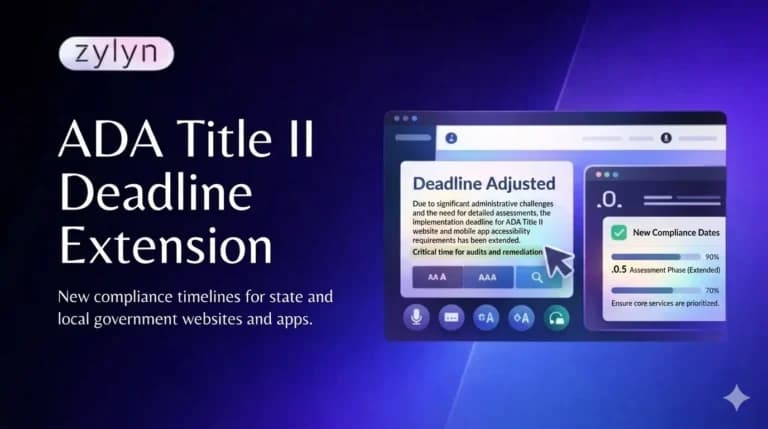
On April 20, 2026, just four days before the original deadline, the Department of Justice did something unexpected: it pushed back the ADA Title II web accessibility compliance deadline by an entire year.
If you work in government, manage a public university, or oversee digital services for any state or local entity, you probably felt a wave of relief. You have more time. But here’s what matters more than the extra calendar days: what didn’t change, what the extension really means, and what you must do right now to avoid being in the same position next year.
The headline is simple. The reality is more complex. And if you treat this extension as permission to pause, you’re making a mistake.
The New Deadlines
The Department of Justice’s Interim Final Rule sets two new compliance deadlines:
April 26, 2027 — Large state and local government entities serving populations of 50,000 or more
April 26, 2028 — Smaller government entities serving fewer than 50,000 people, plus all special district governments (water, fire, transit authorities, etc.)
The original deadline for large entities was April 24, 2026. That’s a one-year extension. For smaller entities, the timeline shifted from April 26, 2027 to April 26, 2028. That’s another year of additional time.
If you run a public college or university, this likely affects you. Public colleges with 50K+ student/employee base fall under the April 2027 deadline.
What Actually Changed ?
Here’s the critical part: The extension changed only the compliance date, not the requirements.
The technical standard remains WCAG 2.1 Level AA — the Web Content Accessibility Guidelines adopted in 2018, now the official benchmark for accessible government digital services.
The scope hasn’t changed. Your websites, mobile apps, social media, learning management systems, and third-party vendor tools are all in scope. If your digital service is “provided or made available” to the public, it must be accessible.
Your ongoing obligations under Title II haven’t changed. Before the deadline, after the deadline, the law requires state and local governments to ensure their digital services are accessible to people with disabilities. This isn’t a new obligation in 2027. It’s been the law for decades under Title II.
The DOJ was explicit: “The extension adjusts the compliance date — it does not suspend the underlying requirement.”
Translation: You don’t get to stop work. You get to spread it out.
Why the DOJ Extended the Deadline ?
The DOJ’s statement said it “overestimated the capabilities of covered entities to comply.” Unpacking this, the Department cited four specific reasons:
1. Staffing and Resource Constraints
Smaller municipalities reported lacking the in-house staff, budget, and accessibility expertise to remediate thousands of pages, documents, and mobile screens. Many have IT teams with 2-3 people managing everything from email servers to water management systems. Adding comprehensive web accessibility remediation to that plate in 12 months proved unrealistic.
Public colleges reported similar constraints—many have one or two accessibility coordinators managing web compliance across hundreds of legacy systems, learning management platforms, and faculty-created content spread across dozens of servers.
2. Technology Limitations
The DOJ admitted it underestimated how difficult automation would be. Specifically:
- Automated remediation tools cannot reliably fix complex educational and STEM content (equations, scientific diagrams, interactive simulations)
- Generative AI promised faster remediation but hasn’t delivered at scale
- Legacy systems can’t be fully automated without manual intervention
- Third-party vendor portals (think enrollment systems, document repositories) can’t be modified by the institution—they’re locked down
The Department essentially said: “We thought technology would be further along by now. It isn’t.”
3. Vendor Lock-in and Procurement Cycles
Many government agencies and universities are stuck with vendor-supplied systems they can’t modify quickly. A state that contracts with a specific company for its permitting portal can’t just swap it out in 12 months. Procurement cycles take time. Vendor accessibility roadmaps take longer.
4. Litigation Risk
The DOJ acknowledged that pushing too hard, too fast created unnecessary litigation risk. Agencies working in good faith but unable to meet the deadline would face legal exposure. Better to extend the timeline, give real time, and enforce meaningfully in 2027.
What DIDN’T Change ?
Disability advocates harshly criticized the extension. The American Council of the Blind stated: “Extending these deadlines denies timely access to essential government services and information, forcing people with disabilities to wait even longer.”
They’re right. And the DOJ acknowledged it. But the DOJ also made clear:
- The obligation to provide accessible digital services exists now, not in 2027
- The technical standard (WCAG 2.1 AA) is the enforceable baseline right now
- Private entities can still sue under Title II for inaccessible digital services immediately
- The extension doesn’t shield entities from litigation; it just extends the compliance date for the 2024 rule
One attorney summarized it perfectly: “The regulatory clock has been reset, not stopped.”
What This Means: Three Key Implications
Implication 1: The Extension Is Not Permission to Pause
This is the mistake many organizations are making. They’re treating April 2027 as a new “start date” rather than an extended “finish date.”
If you haven’t started auditing, you’re now 8-12 months behind where you should be. If you haven’t identified barriers, trained staff, or inventoried third-party content, the extension gives you time to catch up—not permission to delay until 2027.
Table 1: Organizations Using the Extension Effectively vs. Wasting It
| Approach | Year 1 (2026-2027) | Year 2 (2027) | Outcome |
| Effective Use | Audit, prioritize, train staff | Core remediation, testing | Compliance with time for final polish |
| Wasting It | Minimal work, “we have time” | Rushed remediation, legal risk | Last-minute scramble, incomplete |
| High Risk | Delays, false starts, rescoping | Crisis mode, vendor panic | Non-compliance, litigation exposure |
Implication 2: The DOJ Signaled It Might Change the Rule Itself
In the Interim Final Rule, the DOJ wrote: “The Department may issue a new proposed rulemaking on the substance of the 2024 rule during the extension period.”
Translation: The DOJ is considering revisiting WCAG 2.1 AA itself, the scope of coverage, the exceptions, or all three.
This doesn’t mean WCAG 2.1 AA will be watered down. It means the DOJ might tighten it. Either way, don’t bet your compliance strategy on the rule changing. Build for WCAG 2.1 AA. If the rule changes to require more, you’re already there. If it stays the same, you’re compliant.
Implication 3: Enforcement Hasn’t Paused
The DOJ “fully anticipates implementing the regulation at the new deadline.”
What does that mean? When April 26, 2027 arrives, the DOJ expects full compliance. And if you’re not compliant, enforcement—meaning potential lawsuits, settlements, and mandatory remediation—is likely.
Don’t interpret the extension as a signal that enforcement is weak. It’s the opposite: the DOJ is giving you a reasonable timeline specifically so it can enforce meaningfully.
The April 2027 Reality (What Must Happen Between Now and Then)
You have approximately 12 months. Here’s what that timeline realistically allows:
Months 1-3: Inventory and Audit
- Conduct comprehensive accessibility audit of all websites, apps, and digital content
- Inventory third-party systems and vendor contracts
- Document current state: % of content that’s accessible vs. inaccessible
- Identify staffing gaps and budget needs
Months 4-8: Prioritization and Planning
- Prioritize remediation (high-traffic pages first, then student-facing systems, then supporting content)
- Allocate budget and resources
- Create detailed remediation roadmap with specific timelines
- Train content teams on accessibility basics
Months 9-12: Remediation, Testing, and Validation
- Execute remediation plan
- Test with assistive technologies (screen readers, keyboard-only navigation)
- Iterate on fixes
- Document compliance status for legal defense
Critical Issues Government Entities Face (Why the Extension Was Needed)
Understanding why the extension happened helps you use it effectively. Government entities reported four specific barriers:
1. Legacy Document Libraries
Many agencies have thousands of PDF documents (forms, permits, historical records) scattered across servers, websites, and archives. Remediating every document requires staffing that doesn’t exist.
Solution: Prioritize current, actively-used documents. Create a pathway for legacy document accessibility without trying to remediate every 1998 permit application.
2. Vendor-Supplied Systems You Can’t Modify
State licensing systems, permit portals, HR management tools—many are vendor-hosted and locked down. The agency can’t modify the code.
Solution: Work with vendors to update accessibility roadmaps. Include WCAG 2.1 AA requirements in renewal contracts. Consider replacing vendors that won’t commit.
3. Learning Management Systems and Course Materials
Public colleges have thousands of courses spread across multiple LMS systems (Canvas, Blackboard, Moodle, proprietary systems). Faculty-created content isn’t centrally managed.
Solution: Focus on training faculty. Require accessible course design going forward. Remediate high-enrollment courses first.
4. Staffing Reality
Most agencies have one or two accessibility staff managing compliance for the entire organization.
Solution: This is the hard one. Budget for additional staff or contractors. Automation can’t solve this alone.
The HHS Healthcare Deadline Hasn’t Moved
If your organization receives HHS funding (Medicaid, Medicare, healthcare), note: The May 11, 2026 healthcare deadline is unchanged.
Some healthcare organizations assumed the ADA Title II extension applies to them. It doesn’t. If you’re HHS-funded, your deadline was already looming—and it hasn’t moved.
FAQ: Common Questions About the Extension
Q: Does the extension mean my organization can skip accessibility work until 2027?
A: No. The underlying Title II obligation exists now. You can be sued immediately for inaccessible digital services. The extension only delays the 2024 rule compliance date.
Q: Should we update our accessibility roadmap?
A: Yes. Use the extension to spread work across 12 months rather than compress it into 6.
Q: Will the DOJ enforce this deadline?
A: The DOJ stated it “fully anticipates implementing the regulation at the new deadline.” Yes, expect enforcement.
Q: What if our organization isn’t ready by April 2027?
A: Partial compliance with documented good-faith efforts is your best defense. Non-compliance with no evidence of work is the worst position.
Q: Does this affect Section 504?
A: No. Section 504 obligations remain unchanged. HHS-funded organizations still have a May 2026 deadline.
Your Next Step: Get a Free Accessibility Audit
You can’t hit a target you haven’t measured. Run Zylyn’s Free Accessibility Audit to understand exactly where your organization stands against WCAG 2.1 AA.
No credit card. No signup. Just 30-90 seconds of honest diagnostics so you can build a real remediation roadmap.
Because the extension buys you time—not immunity.
FAQ: Questions About the ADA Title II Extension
Q: Does the extension mean we don’t have to be accessible until 2027?
No. The extension delays the deadline, not the obligation. Accessibility is required now. The extension gives entities more time to comply, but barriers must be addressed.
Q: What if we weren’t compliant by the original April 2026 deadline?
The extension applies retroactively. You’re not penalized for missing the original deadline. But you should now be in active remediation. Litigation can still occur.
Q: Is the deadline firm or could it be extended again?
The DOJ signaled it may revisit the rule during the extension period. The extended deadline is likely firm, but monitor DOJ actions. Plan for April 2027 as your deadline.
Q: Does the extension apply to private businesses?
No. Title II covers government entities only. Private businesses (Title III) continue to face thousands of lawsuits and no federal deadline, but expectations are similar.
Q: What WCAG standard do we need to meet?
WCAG 2.1 Level AA is the requirement. Not 2.0, not 3.0 (not ready). Focus on 2.1 AA specifically, which covers websites, apps, PDFs, and documents.
Q: How long will remediation actually take?
Most entities estimate 6-18 months of active work depending on portfolio size. Start immediately because timelines are tighter than you think.
Q: Can we use accessibility overlays instead of real remediation?
Overlays are under scrutiny. The FTC fined an overlay vendor $1M in 2024. Best practice is native remediation, not overlays.
Q: What if we finish early?
Early finish means you’ve already started capturing benefits—reduced litigation risk, improved user experience, expanded market reach. No downside.